Coloured contacts for jirai-kei and lolita: a beginner’s guide
Note: sizing notes and fit reports reflect personal experience. Please confirm details on the official brand site before purchasing.
Coloured contacts for jirai-kei and lolita: a beginner’s guide
One pair of well-chosen coloured contacts changes the face in a jirai-kei or lolita outfit more than any other accessory. A small change to the safety routine prevents nearly every problem people have with them.
If you’ve ever wondered why a jirai-kei outfit looks so different on photo than on you, the answer is usually one of two things: lighting, or the eyes. Coloured contacts (also called circle lenses) are the standard finishing piece. This is what we tell first-time buyers.
Important: coloured contacts are a medical device. The advice below is general — please consult an eye-care professional before wearing lenses for the first time, especially if you wear prescription glasses.
What to buy first
Start with daily disposables in a natural diameter (14.0–14.2 mm). They’re forgiving on the eyes and forgiving on the look.
Three things to look at when choosing your first pair:
- Diameter (DIA): 14.0 mm is close to your natural iris and reads as a subtle change. 14.5 mm and above gives the “doll eye” effect. Beginners almost always prefer 14.0–14.2 for everyday wear.
- Base curve (BC): usually 8.6 or 8.7. If you wear prescription lenses, match what your optometrist prescribed.
- Type: daily disposables (1-day) are safer and require zero maintenance. Monthly lenses are cheaper per wear but need a strict cleaning routine. Start with daily.
For jirai-kei specifically, the most popular looks are:
- pure dark brown (deepens the eye, reads sweet)
- grey or hazel (lighter, more aloof)
- soft pink-brown (very on-trend, romantic)
For sweet lolita: pale blue, lilac, or a warm honey brown.
For gothic lolita: deep grey, violet, or red (red is a statement — don’t pair with a busy print).
How to put them in without panic
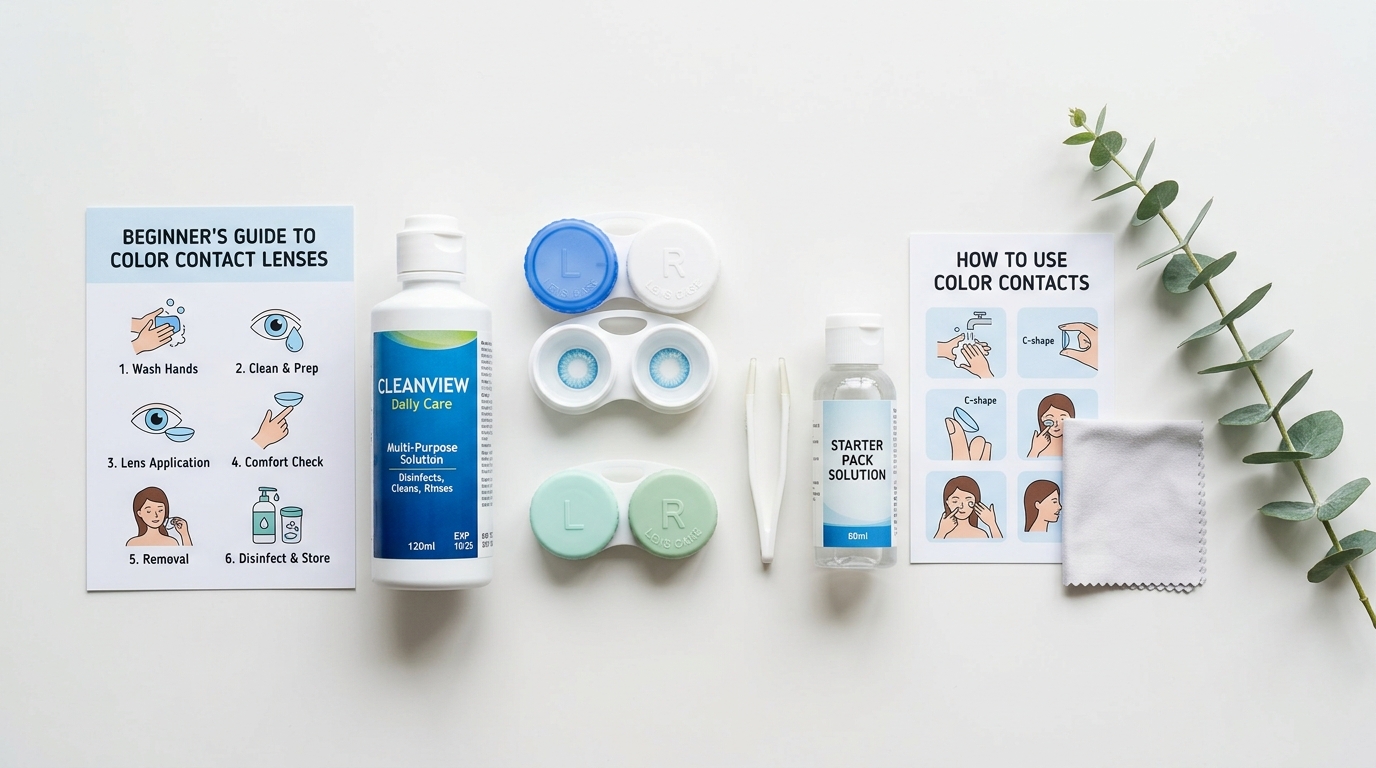
Almost everyone is bad at it for the first three days, then never thinks about it again. Wash your hands, take your time.
- Wash hands thoroughly with fragrance-free soap. Dry them on a lint-free towel.
- Open the blister pack and check the lens isn’t inside-out (a good lens forms a clean cup; an inverted one has a flared rim).
- Place the lens on the tip of your dominant-hand index finger. Pull your upper eyelid up with your other hand. Pull your lower eyelid down with the middle finger of your lens hand.
- Look forward — not at the lens — and bring the lens onto the white of your eye first, then slide it up onto the iris.
- Blink slowly. The lens will centre itself.
If it feels uncomfortable for more than a few seconds after blinking, take it out, rinse with saline (not water!), and try again. Discomfort that doesn’t resolve means stop.
Care routine if you use monthly lenses
Daily lenses skip all of this. Monthly lenses need it done correctly every single day.
You need: lens case, multi-purpose solution (e.g. ReNu, OPTI-FREE), and a habit.
- After taking each lens out, place it in your palm, add a drop of solution, and rub gently with a finger.
- Rinse with solution. Place in the case, filled with fresh solution.
- Never top up old solution. Never use tap water. Replace the case every three months.
If you can’t commit to this, please use daily lenses.
Things you must not do
Most contact lens injuries come from a small number of preventable mistakes.
- Don’t wear lenses overnight (even sleeping for a few hours in non-overnight lenses causes corneal swelling).
- Don’t wear them in pools, hot springs, or showers — risk of acanthamoeba keratitis is real.
- Don’t share lenses, ever.
- Don’t exceed the wear time. Daily lenses are for one day. Two days isn’t “twice the value,” it’s a serious infection risk.
- Don’t ignore irritation. If an eye feels gritty, blurry, or red, take the lens out and don’t wear contacts until it’s fully better.
A quick decision tree
Three questions decide what you should buy first.
| Question | If yes | If no |
|---|---|---|
| Do you already wear glasses? | Get the BC and DIA from your optometrist before ordering | Standard 8.6 BC is usually fine |
| Will you wear them less than 3 times a week? | Daily disposables | Monthly is fine if you commit to care |
| Do you want subtle or dramatic? | 14.0–14.2 mm for subtle | 14.5 mm+ for dramatic; 14.8 mm+ for full doll-eye |
In short
Get daily disposables in 14.0–14.2 mm in a natural brown for your first pair. Wash your hands, take your time, and never wear them in water. Once you’re comfortable, experiment with diameter and colour. The face change is real, and the safety routine is short.
Sources / further reading
- Editorial review by the Yumekawa Plus team.
- General consumer guidance from optometrist resources; please consult a professional for personal advice.
スポンサーリンク
Tags
スポンサーリンク